Astra has helped me cross off another ~17 year old “I will never actually do this” bucket list item recently, sharing in case others are as mesmerized as I am. This is a high resolution (8k), immersive rendering of a ~10 year old cosmological simulation from the IllustrisTNG collaboration.
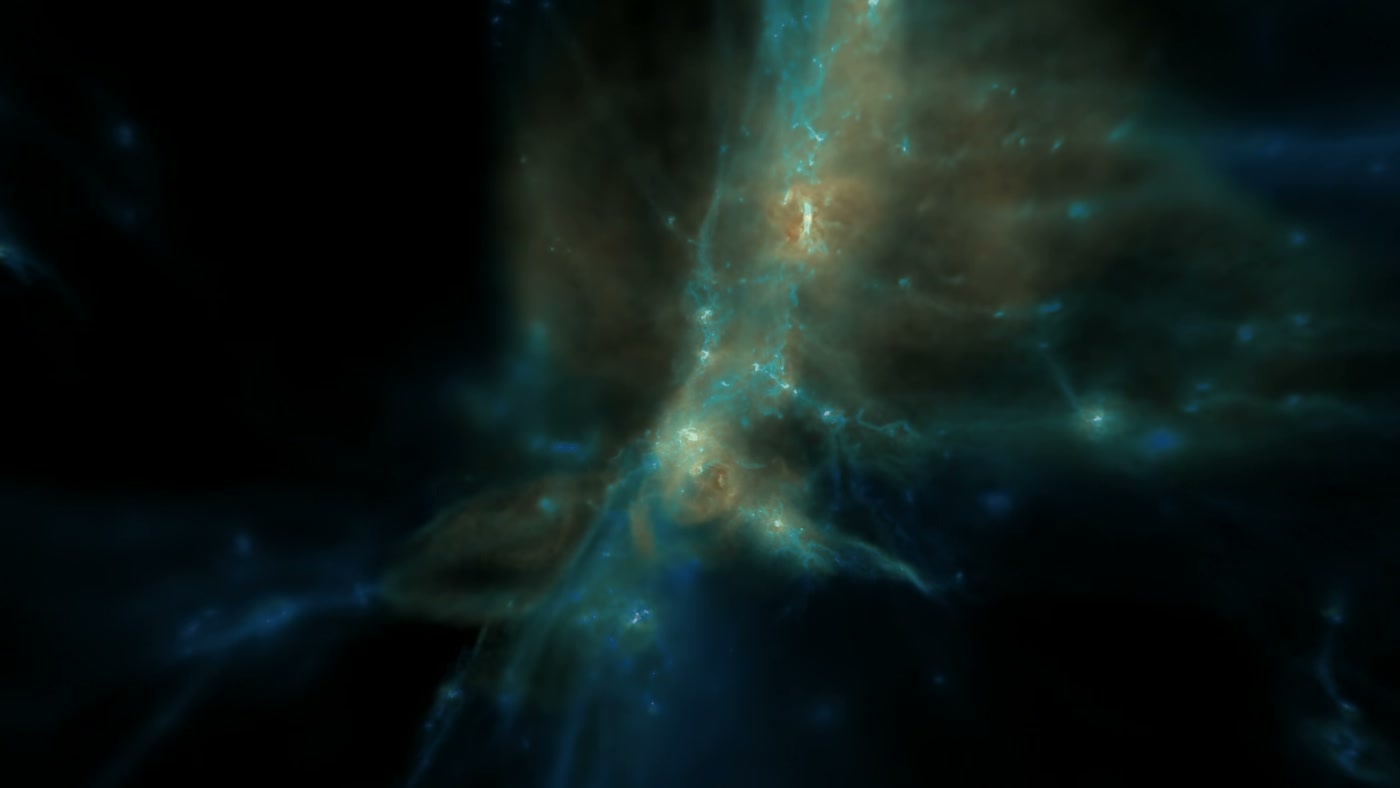
9 minutes 45 seconds · Sound on · Optional narration
A cosmological simulation involves some combination of physics accuracy (inclusion of magnetic fields, baryon physics, etc etc) and a choice of scale (larger scales = more large scale structure but less small-scale physics, more small-scale physics = less volume). These are used to help us study and understand large scale structure, cosmological models, galaxy formation models, etc.
Recreational renderings of cosmological simulations is not a new idea, and many of them may be of higher quality than this one, but ever since working with these kinds of simulations back in this era, and after a cool experience as a first semester Freshman working with George Francis in the Illinois Simulator Laboratory to port a cosmic ray shower into The Cube [1] for my Ma198 Hypergraphics course at UIUC I’ve wanted to enter a cosmology simulation immersively, at the highest quality I could.
To that end, I made this experience for VR specifically. However I personally am quite happy with the browser experience as well, which is a pleasant surprise! This is why I think it’s worth sharing since you can enjoy it even without a VR headset. Of course, the better the headset the better the experience — as a VR fanboy I am one of the approximately 10 users of the Apple Vision Pro and also an owner of a Meta Quest Pro (purchased with a nice hefty employee discount).
Astra helped me choose the TNG100-2 simulation variant (a box about 110.7 comoving megaparsecs across — a megaparsec is 3.26 million light-years; this film shows a subvolume 11.1 comoving megaparsecs across) as a good sweet spot — includes a lot of physics (e.g. magnetic fields), has enough saved checkpoints to make a really compelling experience, and is affordable (this cost me ~$15 to make). For reference, producing the original TNG100-2 simulation required 2,688 CPU cores and about 600,000 CPU-hours. There is an even higher resolution simulation at this scale which is the TNG100-1 simulation, and I hope to migrate to this but a full remake would be much slower and, by our current estimate, roughly an order of magnitude more expensive to produce: TNG100-1 has eight times finer mass resolution and nearly twice as many saved subbox outputs.
I’ve tried to add some annotations that help you understand what you’re looking at, but you can turn these off if they annoy you. The one remaining slop factor that I actually kind of like is the AI-generated score generated with image inputs and Elevenlabs. That can be turned off as well if offensive to your tastes. But consider: the AI score kind of completes the picture: a computer-generated score for a computer-generated universe.
There is also an optional narration (also AI generated) you can turn on but I found this a bit too annoying for my liking and I stopped trying to iterate on it. It does have some valuable info though!
The remaining todos that I’ve forced myself to push in order to share this is an accurate visible light rendering of the last frame to know “what would this actually look like if I was in this spot” and to switch from TNG100-2 to the TNG100-1 simulation, which has much higher resolution.
[1] The Cube is an incredible 2000-era project (also known as ALICE — Adaptive Laboratory for Immersive Cognitive Experiments) created in the basement of Beckman Labs: a room that can fit ~5 people, with each surface of the room being a stereoscopic projection screen. Participants wear shutter glasses for a shared VR experience. By 2009 this was pretty dated hardware but the experience was still pretty phenomenal (at least according to memory). Only limitation was the fact that only a single user actually got the geometrically correct viewpoint.